
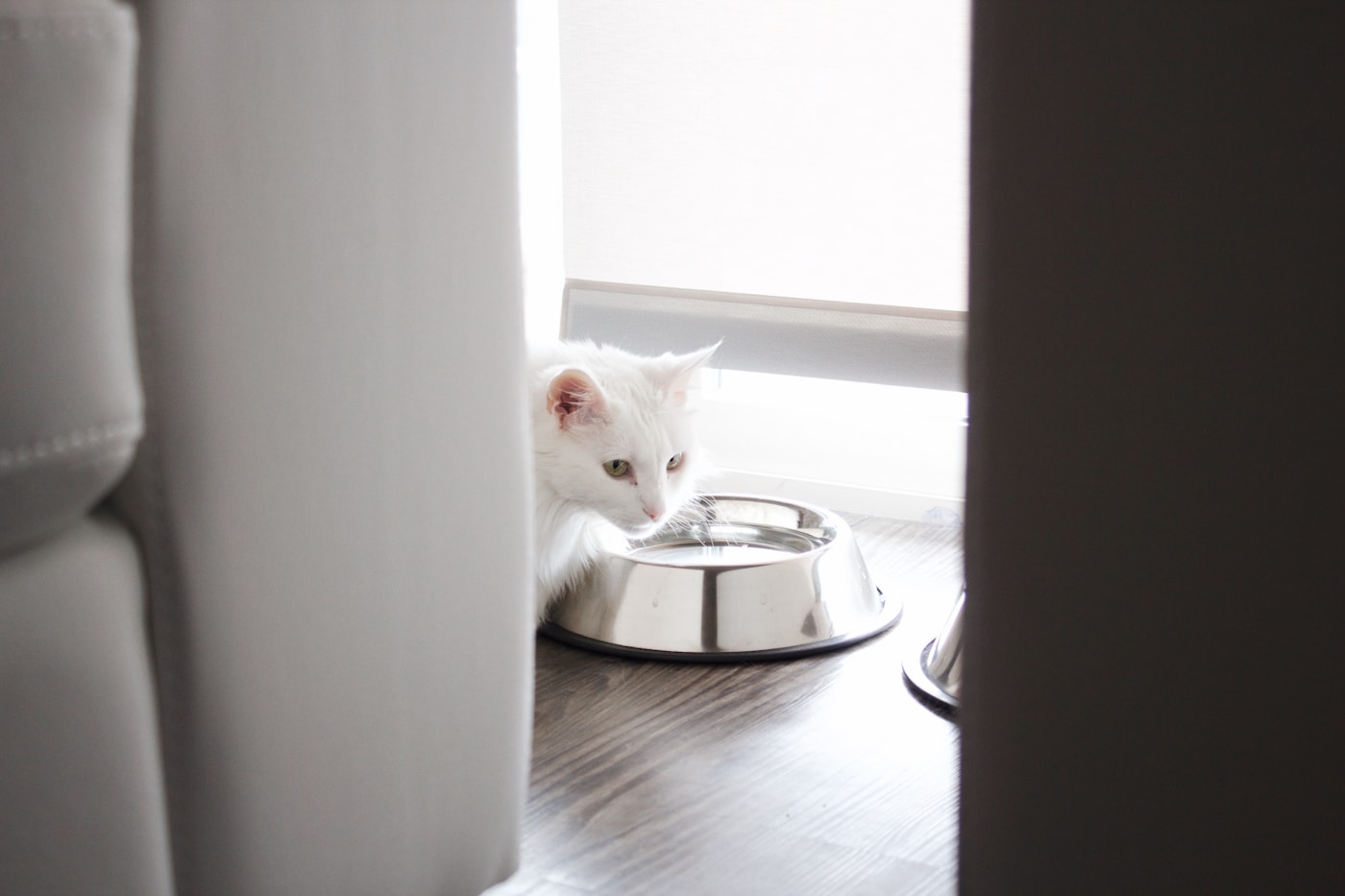
The best place for a cat water fountain in a small apartment is a quiet, easy-to-reach spot away from the litter box and not directly beside food. It also needs a protected power route, a washable surface, and enough open space for the cat to approach without being cornered by people or another pet.
Do not choose the location from a floor plan alone. Test the proposed spot with your cat’s current water bowl for seven days, then score what actually happens. A workable location is more valuable than a stylish one that the cat avoids or the household cannot keep clean.
Who this test is for
This test is for a cat owner trying to fit a fountain into a studio, apartment kitchen, compact living room, or other home where every wall and outlet already has a job.
It is a placement exercise, not a way to measure hydration or diagnose a health problem. A sudden increase or decrease in drinking, repeated visits to water without drinking, vomiting, weakness, or other concerning changes belong with a veterinarian rather than a product experiment.
Start with three candidate locations
Walk through the apartment and identify three possible spots. Each one should pass these basic checks before it reaches the seven-day test:
- The cat can reach it at any time without a closed door.
- It is physically separated from the litter box.
- It is not directly beside the food bowl.
- Another pet cannot easily block the only approach or exit.
- The fountain cord would not cross a walkway or sit where water can collect around a plug.
- The floor or mat can be wiped and dried easily.
- The fountain would have clearance for air, refilling, and disassembly according to its manual.
Feline environmental guidance recommends distributing key resources such as food, water, toileting, scratching, play, and resting areas rather than clustering everything in one corner. It also recommends separating food from water and providing choices where possible. The full reasoning appears in the AAFP and ISFM Feline Environmental Needs Guidelines.
In a very small home, separation does not require a different room. A different wall, the opposite end of a counter, or a quiet living-area corner may create enough practical distinction to test.
Use the current bowl before moving the fountain
Place the cat’s familiar water bowl in candidate location one. Do not buy a new fountain for this stage, and do not remove every other water source. The aim is to test the location without mixing in pump noise, a new material, moving water, or a different drinking height.
Mark the bowl’s fill level at the same time each morning. This is only a rough household observation because evaporation, spills, and refilling make it unsuitable as a medical measurement. More importantly, note whether the cat approaches comfortably, whether household activity interrupts drinking, and whether the spot remains easy to maintain.
International Cat Care advises offering fresh, clean water away from the eating area and introducing a fountain gradually. Its guide to encouraging cats to drink also emphasizes regular fountain disassembly, cleaning, and filter replacement according to the manufacturer. That makes owner access part of a good location, not an afterthought.
The seven-day fountain-location scorecard
Score each item from 0 to 2 at the end of every day:
| Test | 0 points | 1 point | 2 points |
|---|---|---|---|
| Cat access | Access was blocked or the cat appeared trapped | Access was occasionally awkward | The route stayed open with more than one way to leave |
| Household traffic | Drinking was repeatedly interrupted | Some passing traffic occurred | The spot remained calm during normal routines |
| Noise | Appliances or activity made the area noisy | Noise was occasional | The area stayed predictably quiet |
| Separation | Beside food, litter, or another contested resource | Some separation, but resources still felt clustered | Clearly separated from food and litter |
| Cleaning | Hard to reach, wipe, or dry | Manageable with extra moving | Easy to lift, wipe, refill, and inspect |
| Spill risk | Water reached a cable, plug, walkway, or vulnerable surface | A mat or small adjustment contained it | Spills stayed on a safe, washable surface |
| Observed use | No comfortable approaches observed | The cat investigated or drank occasionally | The cat approached and drank without hesitation |
The daily maximum is 14 points. Add the seven daily totals for a maximum of 98.
- 80-98: strong candidate; confirm the real fountain’s dimensions, cable, and cleaning clearance.
- 60-79: workable, but fix the lowest-scoring condition before setup.
- Below 60: test a different location rather than trying to force this one.
The score is an editorial decision tool, not a veterinary standard. Its purpose is to make seven days of household observations comparable and prevent one convenient-looking outlet from making the decision by itself.
What to observe during an ordinary week
Include normal life in the test. A location that works only when the apartment is silent may fail beside a running dishwasher, vacuum, television, washing machine, or busy entrance.
Watch the approach as well as the drink. Does the cat pause because a person is cooking? Can a dog stand between the cat and the bowl? Does the cat have to squeeze between furniture? Is the only exit behind the cat? Does the bowl collect food crumbs or litter particles? These observations reveal problems a tape measure will not.
Do not deliberately frighten the cat, create noise, restrict water, or stage competition to test the location. Observe normal routines only.
Check the real fountain footprint
Once a location passes, use masking tape or paper to mark the fountain’s full footprint. Include room for the power connector, cord route, lifting the reservoir, and removing the pump or filter. Check the manufacturer’s instructions before deciding how close it may sit to a wall.
Then rehearse one refill and one cleaning movement with an empty bowl or container. If a chair must be moved, a cable unplugged behind furniture, or the fountain carried over a rug every time, maintenance friction will add up.
Before choosing a design, compare cat water fountain types and cleaning access. For the wider area around bowls, mats, and storage, use the Petpickr feeding setup guide and pet bowl selection guide.
Introduce the fountain without removing choice
Put the cleaned fountain in the successful test location and keep the familiar bowl available elsewhere during the transition. Follow the fountain manual for assembly, minimum fill level, cleaning, filter use, and electrical precautions.
Some cats investigate moving water immediately; others need time or continue to prefer a plain bowl. A fountain is an optional water source, not proof that the cat will drink more. In a multi-cat household, separated water stations are especially useful because one cat should not be able to control access to every drinking point. The 2024 AAFP intercat tension guidelines specifically recommend multiple, visually separated food and water stations when managing shared resources.
When the test should stop
Stop rearranging the apartment and contact a veterinarian if the cat suddenly drinks much more or less, stops drinking, strains or vocalizes around urination, seems weak, vomits repeatedly, or shows another abrupt health or behavior change. Location testing cannot determine whether a drinking change is environmental or medical.
For a newly adopted cat, keep the first setup predictable and make changes gradually. Petpickr’s new-cat preparation checklist can help organize water, litter, hiding, scratching, and rest without crowding all resources together.
Practical verdict
A small apartment does not need a perfect fountain corner. It needs a location the cat can reach calmly and the owner can clean consistently. Test access, traffic, noise, separation, cleaning, spill risk, and actual use for one ordinary week. If the spot scores poorly, move the bowl before buying or replacing the fountain.
The smartest placement is the one that still works on a busy evening, not just the one that looks tidy in a product photo.
FAQ
Should a cat water fountain be next to the food bowl?
Usually not. Feline environmental guidance recommends separating food and water resources, and distance also reduces the chance of food reaching the water. In a compact home, try a different wall or the opposite end of the room.
Can a cat fountain go beside the litter box?
Choose a different location. Drinking and toileting resources should be physically separated, even when an apartment is small.
How long should I test a fountain location?
Seven ordinary days provides a more useful picture than one quiet afternoon because it includes cleaning, cooking, visitors, workdays, and changes in household traffic.
What if my cat ignores the fountain?
Keep a familiar plain water bowl available, check whether the fountain is noisy or exposed, and try a second safe location. Contact a veterinarian if drinking changes suddenly or the cat appears unwell.
Related reading
Product context for this topic
Use the related buying guides for where to put a cat water fountain in a small apartment: a 7-day test to compare materials, sizing, care, safety context, and current merchant policies before choosing a product.
Next step
Keep reading before you buy
Use the related guides for deeper product criteria before visiting merchant pages.